We break down the most common administrative tasks after moving and explain them in plain language.
If you think that after moving to Spain all difficulties are behind you, that’s not the case. After moving to Spain, you will face no less burdensome bureaucratic processes: registration, obtaining an appointment, gathering important certificates and documents without which you won’t gain access to a number of services. That’s why we are here to explain all the important migration steps and bureaucratic processes before and after moving in simple terms.
If you plan to apply on your own, you definitely need to know how the submission process works. We provide a step-by-step scheme:
First, you must check that all necessary documents are ready. You can find the complete list of documents for residency in the first article or on the website page. By the way, there is one important question we discussed earlier: for each residence permit in Spain, you need to provide a certificate of no criminal record. But what if you have a criminal record or had one? Having a criminal record complicates things significantly, but it doesn’t always make obtaining a residence permit in Spain impossible. It all depends on the nature of the crime, how long ago it was, and the circumstances. There are chances of approval with a criminal record if it has been expunged and if there were no serious crimes. The main thing is to prove rehabilitation.
If you or your family members have a criminal record, it’s better to contact us — we know how to obtain approval even in such cases. We have many cases where we fully supported individuals with criminal records and heroically achieved approval. So, if you have problems with documents, certificates, or simply have a complex case that doesn’t promise approval on paper, come for a consultation with our experts — we will find a solution. You can find the application for a consultation below.
Next, after gathering the documents, you need to check them all and have them translated along with an apostille — this is mandatory.
All documents from government bodies must be apostilled, except for civil registry documents. And they must be translated into Spanish and certified by a sworn translator. The translation is attached to the original with the apostille. If you apply through us, you don’t have to worry about apostilles and translations — we have contacts with reliable specialists who will do everything quickly and reliably. If you are applying on your own, it’s better to find a good, reliable company that has been doing this for years. After all translations, you can proceed to the submission.
There are two options for how to do this: Arrive in Spain and apply through the UGE office or submit your application through the Spanish consulate.
If you choose the second option, be prepared for the document review process to take longer. The consulate's task is to verify the documents, and if everything is fine, they will then issue you an entry visa to Spain: this is a multi-entry visa valid for a year for applying for a residence permit from within Spain. So, with this option, you will need to submit documents twice, which delays everything. The consulate's processing times are 2–3 months. In Spain, this process is faster: about 20 days. Applying through the consulate is the optimal option for those who have problems obtaining a visa.
However, if speed and a high likelihood of approval are important to you, it’s better to switch to the second submission option:
Obtain a tourist visa, fly to Spain, and submit your application through the UGE office. If you have not had a Schengen visa or have been denied, it’s better not to rush with the visa and contact us — we will help you with the application; we have reliable specialists who handle Schengen visas from start to finish. If you are applying for a Startup, you will also need to send a ready business plan to the ENISA office at this stage.
And now information for those who do not live in Russia: there are cases when people moved to other countries after 2022, for example, to Serbia, Georgia, or Armenia, and they encountered problems with apostilles. Here’s how we solve such cases: we share contacts of contractors who can apostille documents remotely. After all these steps, you should receive the long-awaited approval. Or a request for additional documents — this is when you need to send some missing documents or certificates. There’s no need to be afraid of them; the main thing is to respond within the time frame set by the agency.
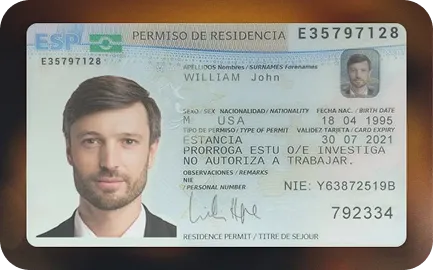
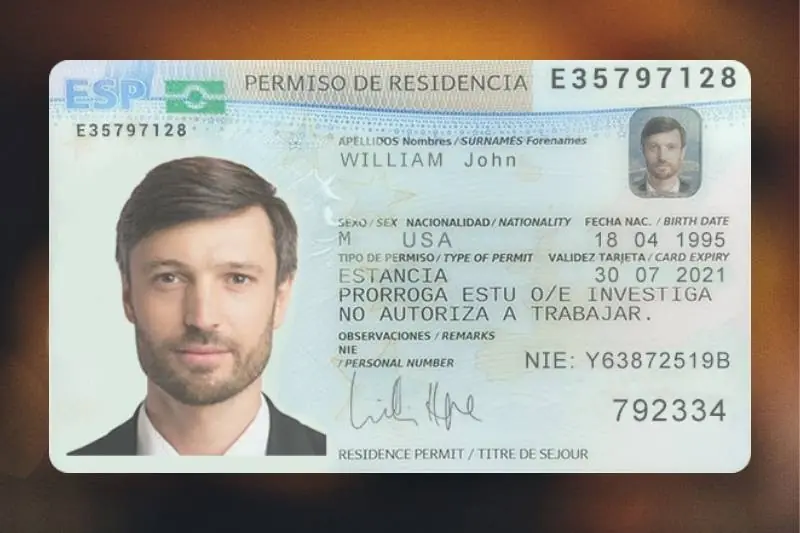
After the approval of your residence permit in Spain, you will be assigned one of the most important documents — NIE, the foreigner's number. If your family is applying with you as dependents, they will also receive this personal number. It is needed to open a bank account, register property, obtain driving licenses or permits, register a business, and submit official applications. Here’s what this document looks like:
You need to arrange a Sita in advance – an official appointment for visits to government institutions. We arrange a Sita for each of our clients for biometric data submission — this option is included in all our packages. You will need a Sita not only for biometric data submission. You will need to arrange it every time you want to visit: any migration services, police stations, tax offices, medical centers, as well as social security and the town hall – the equivalent of the Russian MFC.
Sitas are not easy to obtain; their number is limited, and you may simply not have time to arrange anything. Sometimes you have to wait more than a month for one, and sometimes a week is enough. It all depends on the agency in Spain and your mobility — if you want to speed things up, you will have to go to another district — you can submit fingerprints throughout the province, in any chosen district. We sometimes do this — sometimes we take a Sita in Barcelona in advance and wait, and sometimes, to speed things up, we can go outside the city — there, you can get a Sita in a week.
Now that we’ve sorted out the Sitas, let’s move on to the next steps of the application process.
As soon as you arrive in Spain, you need to scan your passport with the arrival stamp page. If you enter through another Schengen country, you need to prepare an Entry Declaration and have it stamped at the police in the airport. You can also do this at the train station or in the city itself. We always provide detailed guidance to our clients on how to find the right office for the necessary certificates in each city.
The declaration must be completed within 72 hours of crossing the border. Moreover, this time needs to be confirmed: receipts and any written confirmations can help here. Life hack: at the border with Spain, stop by the nearest store and buy something tasty — and be sure to ask for a receipt. You can show it to the inspectors, and there will be no questions.
Next, we submit documents online for obtaining residence in Spain through the agency — for this, you need an electronic certificate. We explained how to obtain it independently in module number 4 about taxes and finances, but if needed, we arrange this certificate for all our clients. From the moment you upload the documents, you can stay in Spain in a legal status — this is a big plus.
Then we wait for approval, and only after that do we take the Sita. The Sita will indicate the time you are expected at the police station, and everything is done on-site in a live queue. If you happen to be late — it’s not a problem; they will accept everyone. After approval, you will need to undergo biometric data submission. When this will happen depends on the Sita, but the procedure can be completed in one day.
On-site, you will be asked to sequentially place each finger on a special scanner. You will be asked for documents with photos, which will be scanned. These photos are attached to a paper where you are asked to sign, and then everything is scanned into the database, and all this information along with the photo is 'applied' to your residence card. It’s important that children from 3 years old are also asked to sign. If they don’t have a signature, they can simply write their name. Moreover, all children need to be taken for biometric data submission: even infants. The police need to ensure that the stated family composition is real.
After completion, you will be given a receipt, which serves as temporary confirmation of your legal status in Spain until you receive the finished card. You must keep the receipt; you won’t receive the card without it. It will contain all the important information: where to go, how many days, what to bring. It will also state whether the appointment is with or without a Sita. There can be two options.
Next, you will need to arrange another Sita, but this time for obtaining the card — yes, without a Sita, you can’t go anywhere in Spain. Usually, it is made within 30–45 days on average, but the timeframes vary significantly depending on the city and the workload of the offices. In Barcelona, for example, the stable timeframe is 30 days, while in other provinces, it’s longer. You can check the readiness of the card by number on the same website where you get the Sitas — select the service 'Obtain card', and at the very top, it will say 'Issued X lot'. If you see your lot number, it means the card is ready.
When you receive the notification, you will need to fly back to Spain again if you haven't decided to stay, and bring the following documents with you: Your passport and the stamped document you received from the police after submitting your fingerprints. The passport is only needed for identification purposes, even if it is expired, that’s not a problem. Only with both of these documents will the police be able to issue your card.
It’s better to contact the police — at the National Police (Policía Nacional) or the Civil Guard (Guardia Civil). They will issue you a document, an official report of loss, and from that moment you will have 30 days to make a duplicate if your card is not found. To obtain a resident card in Spain, you need to immediately schedule a biometrics appointment. If you lose the document upon departure, it may complicate the justification of your legal residence. To enter the country, you will need to present the 'Regresso' document or postpone your trip and wait for the card to be received. The main thing in such situations is not to panic and to act according to the plan.
Either after passing the biometrics, you can receive the 'Regresso'. This document allows you to leave Spain and re-enter the country once within the next three months to collect your completed card.
1) Incorrect or insufficient proof of income. This is not related to the income itself, but when bank statements are not synchronized by dates with contracts and declarations or when there is no clear indication of remote work format. Some may provide assets that cannot be quickly accessed: real estate without rental, closed deposits – this is a direct path to denial. Provide all official statements for the last 3–6 months, contracts, payment orders, and transfer prints. Show liquid income. Spanish inspectors are very meticulous on this topic and will not let you pass just like that.
2) Also, the difference in currencies. A common reason for denial is when income is calculated at the wrong euro exchange rate. The rate always changes, so it needs to be checked before submission.
3) Errors often occur with apostilles and translations. To avoid this, look for specialized professionals with good experience who deal with apostilles on originals and sworn translations into Spanish. And if you don’t have such specialists in mind – you know who you can always turn to. Moreover, apostilles and consular legalization of documents are needed even if the document was obtained outside your country. This is where errors can arise: for example, copies may be certified instead of originals. Or in some countries, consuls are legally not allowed to certify signatures for document submissions. It’s difficult to control all this yourself, so it’s better to contact us – we will find a solution ourselves.
4) The same goes for sworn translations: some languages are not available for translation. For example, there is no practice of sworn translations from Armenian to Spanish – such documents cannot be certified. We know how to handle such cases: we can request a translation in two languages or make a cross-translation.
Also, pay very close attention to dates — even a small mistake in a date or name can lead to a denial of your residence permit in Spain. It’s best to check all documents at least 3 times — names, dates, numbers must match exactly.
It’s also worth discussing the relevance of certain requirements.
The realities of the migration world are such that the list of documents in the law and the regulations of the agency may not always be up to date. The agency in Spain regularly changes document requirements but does not always officially announce this. For example, apostilles were not required before, but now they are. Such changes can occur weekly, affecting all subsequent cases. That’s why we are constantly monitoring: we know what rules or requirements are being introduced or changed, and we immediately implement everything new into our casework.
The biggest mistake is if you apply for a residence permit in Spain for the first time on your own, without any legal support. More than 30% of denials are related to formal shortcomings that could have been avoided. There is often unverified information on the internet that is presented to us as truth. Even if everything is checked thoroughly, you may receive an unexpected request for additional information — we have experienced this more than once, when everything is correct on paper, but the Spaniards send questions clarifying some details they didn’t like. This is already a common practice.
To avoid this, you can speak personally with our expert on residence permits in Spain – he will explain in detail what documents are needed for submission, how to avoid additional requests, and what to pay attention to. You can register by clicking the button below.
The first thing you need to do is obtain registration (empadronamiento) at the town hall. Without this, you will not be able to access free healthcare, schools, language courses, or even schedule an appointment for residence permit renewal.
First, you need to find an apartment – it’s best to immediately make a long-term rental agreement so that you can register without problems.
How to obtain this document was explained in the article about healthcare. Today we will briefly explain:
You need to find the nearest Ayuntamiento, the equivalent of a multifunctional center, and submit an application for registration — this can be done online. You need to bring the following documents:
Attend the appointment at the town hall on the scheduled day. The staff will check the documents, enter the data into the registry, and issue a resguardo — a temporary confirmation of registration. The actual certificate can be obtained immediately or within a few days.
Next, after registration, you need to obtain a social security number (Número de Seguridad Social). This is a registration number. It is mandatory for official employment, pension accrual, and receiving benefits. To obtain it, you need to submit an application online through the official platform — after registering with social security, you will have a personal account on the website where you can 'attach' each family member.
You will need an electronic certificate — if you don’t know how to obtain it, contact us or read the article about finances and taxes. You will need documents: a completed application and NIE. Furthermore, if you plan to live in Spain for more than 183 days, you need to register with the tax office (Agencia Tributaria). This is necessary if you have the status of Autónomo.
You can also register online if you have an electronic signature. After registration, you need to obtain a Spanish health card – get a health insurance number. Timeframe: within 1-2 months after moving. It will grant access to the Spanish public healthcare system in Spain. Without it, you cannot make an appointment with a doctor in public hospitals and health centers.
Don’t forget about your driver’s license, as this issue is more complicated: Starting from June 2025, Spain introduced an online system for exchanging licenses for citizens of countries with agreements. But Russia is not on this list, so Russians will need to take exams to obtain a license in Spain. Russian licenses can only be used if you are in Spain on a tourist visa or for up to 6 months of residence on a residence permit – after this period, only training in a driving school.
Be prepared to retake the driving test. Training in a driving school costs about 300–500 euros for the theoretical course and about 25–50 euros for each practical lesson. However, the training system in Spain is similar to that in Russia, so we are confident that if you have a license, you won’t face difficulties in passing the test. Attending a Spanish driving school is always beneficial: Spain has its own peculiarities in traffic rules that may differ from Russian ones. It’s important to know this. Also, transfer your driving experience to the new license. This will affect the cost of insurance.
These are the main documents that need to be arranged upon arrival in Spain. We have discussed the rest in detail in other articles – you can find them by topics in the Blog.
Now you know what steps you need to take first after moving and how the process of applying for a residence permit and obtaining a card generally works. If you want everything to go smoothly — don’t hesitate to ask for help from us — we will find the answer, suggest any solution, or share contacts.
Strictly necessary
Required for the site to function
These cookies are essential for the website to work and cannot be disabled. They remember your language preference and your cookie decision so the banner doesn’t reappear
Analytics & performance
Anonymous visit counting
Let us count visits and traffic sources (search, social, direct) to understand page popularity and improve the site. No personal data is collected
Your rights
You can change or withdraw your consent at any time by clicking «Manage cookies» in the site footer. This is as easy as giving consent. You also have the right to access, correct, or delete your data by contacting us at hello@relospain.com