What is important to know about the private and public systems, insurance, pediatricians, and emergency care.
Today we will discuss a very important topic for everyone planning to move to Spain – healthcare and the healthcare system. We will answer the following questions:
There will be a lot of important information, so it's better not to delay and start right away with the first topic: insurance.
Health insurance in Spain is one of the key and main documents. If you do not have it, you simply will not be issued a residence permit. What types of insurance are there? We need just two. The first is public insurance. This is a free and universal healthcare system. For expats, it is available only if they:
In other cases, you need to obtain a private health insurance policy. This is private health insurance in Spain. It is purchased from Spanish insurance companies approved by a special registry. It covers outpatient and inpatient treatments, specialists, and hospitalization.
Cost – from €40 to €90 per month. For comparison, a doctor's appointment without insurance costs an average of €100.
With private Spanish insurance, you can make an appointment with any specialist directly, without a therapist and without waiting. It is available to everyone who does not have access to the public insurance system or who needs insurance for a visa or residence permit in Spain. That is, to obtain a residence permit, you need to obtain private insurance, and only then can you apply for public insurance.
There is also travel insurance, which is not suitable for obtaining or renewing a residence permit but can be useful during your stay in Spain as a tourist.
1. Choose the appropriate term for the insurance and payment option
For most residence permits, private insurance is initially obtained for 12 months, and
then the policy is renewed annually. There are also different payment options: quarterly or upfront for a year. If you apply as a nomad-autonomous, you can qualify for public insurance, as contributions to social security are mandatory for this status.
2. Choose an insurance company.
After choosing the type of residence permit in Spain and its duration, you need to select an insurance company. Make sure it is registered in the national registry (DGSFP/Registro de Entidades Aseguradoras). Among the most well-known companies are Sanitas, Asisa, DKV.
3. Ensure that the policy meets key official requirements:
With the correct issuance of the policy, you will receive not just a card, but a full certificate of coverage. It is important to check the policy yourself. Make sure there are no errors, it meets all requirements, and includes the names of all applicants.
If you find it difficult to navigate all this, you can contact us – we will gather your documents turnkey, including insurance, and explain how to use it all. For this, you only need to take one step – come for a consultation. The link will be at the end of the article.
Spain is a country with a universal, developed public healthcare system. According to many rankings, Spanish healthcare ranks 3rd in the world in terms of quality and accessibility. Some facts: Spain allocates about 10% of GDP to healthcare and ranks sixth in the EU in the number of doctors. There are four doctors for every thousand people. Now let's compare Spanish healthcare with Russian healthcare to get the full picture.
The public healthcare system in Spain covers 99.5% of the population, funded by taxes and contributions to social security. In Russia, the system is similar, based on mandatory health insurance, but the level of healthcare and hospital equipment raises questions. In Spain, everything is at a higher level. Here, cancer is treated for free, and patients from all over the world come here to improve their vision or treat eye diseases. These services are available in both public and private clinics.
Emergency services in Spain operate differently than we are used to. For example, if you break your leg, you will have to get to the hospital on your own, as an ambulance will only come if you cannot move. If you do not have insurance, calling an ambulance will cost you 600 euros. All this is done to ensure a high level of response: ambulances in Spain arrive in a matter of minutes, and assistance is provided just as quickly.
To call an ambulance, you need to dial 112 – the unified emergency service number. In some areas of the country, there is an ambulance call number 061. But keep in mind – you will most likely have to communicate in Spanish.
It is also important to understand that Spain has completely different medical protocols compared to Russia: different medications, different reactions from doctors. Some may feel that doctors here are more indifferent, but that is not the case. They all work according to protocols and know exactly when to be concerned and when it is better not to make unnecessary movements.
Spain stands out with high life expectancy and quality of healthcare.
The average life expectancy in Spain is about 83 years. In comparison, this figure is significantly lower in Russia – about 73 years. The secret to the longevity of Spaniards lies not only in medicine but also in their lifestyle. People here do not pay attention to age and remain active even at 60-70 years old. Tennis, walking, swimming, and constant communication with others are an integral part of their lives.
Spain also has a well-developed family doctor system, which monitors patients and refers them to specialists. In Russia, there are hospitals where you can seek primary care, but often you have to stand in long queues due to a lack of doctors.
The public healthcare system in Spain is funded by the social security tax Seguridad Social, which is paid by all working citizens and residents. To use this system after moving, you need a health insurance number, which is issued at the place of registration and based on the NIE – the foreigner's identification number. If you have a residence permit in Spain but live in rented accommodation and have not registered, you will not be able to obtain an individual health card and gain full rights in the public healthcare system. For this, you need official registration of your actual residence address.
There is a solution. Again, you can live with private insurance. This is voluntary private health insurance – in Spain, more than 25% of the population has it, most of whom are expats. This private insurance allows:
You need to register at your place of residence with the local administration. After that, a registration certificate will be issued, which is necessary to obtain the number.
Without registration, you will not be tied to any medical center, meaning you will not be able to get your family doctor, use free medical services, or receive prescriptions. You will only be able to rely on emergency medical assistance.
Additionally, you will need a social security number. To obtain it, you must submit an application online.
This is convenient, as you can register through the official platform — after registering with social security, you will have a personal account on the website where you can 'attach' each family member. You will need an electronic certificate — if you don't know how to obtain it, contact us or read the article about finances and taxes.
You can discuss any questions and receive a comprehensive strategy for obtaining residency at a free meeting with our expert. You can book a spot using the button below.
The documents needed for registration with social security are: a completed application and NIE. After registering with the social security fund, a certificate is issued stating that the registered person is entitled to medical assistance. This certificate will be needed to apply for a health insurance number. For this, you need to visit the nearest public health center.
If you have registered your residence, you need to visit the nearest health clinic in Spain, Centro de Salud. You should bring the following documents:
Once all your documents are checked and you are registered in the system, you will be issued an individual patient card. From this moment, you can make appointments either online, through the app, or in person at the clinic's reception, providing your medical card number.
When arranging insurance, the agent provides a list of available hospitals that cooperate with the company. In the insurance app, which can be installed on your phone, there is an electronic policy card. You can choose a convenient hospital and make an appointment with the necessary specialist. In case of an emergency, for example, with a high fever or injury, you can go to any hospital, including public and private ones. This is also possible with private insurance. Using private healthcare in Spain, you may encounter English-speaking or even Russian-speaking doctors, which is convenient for foreigners.
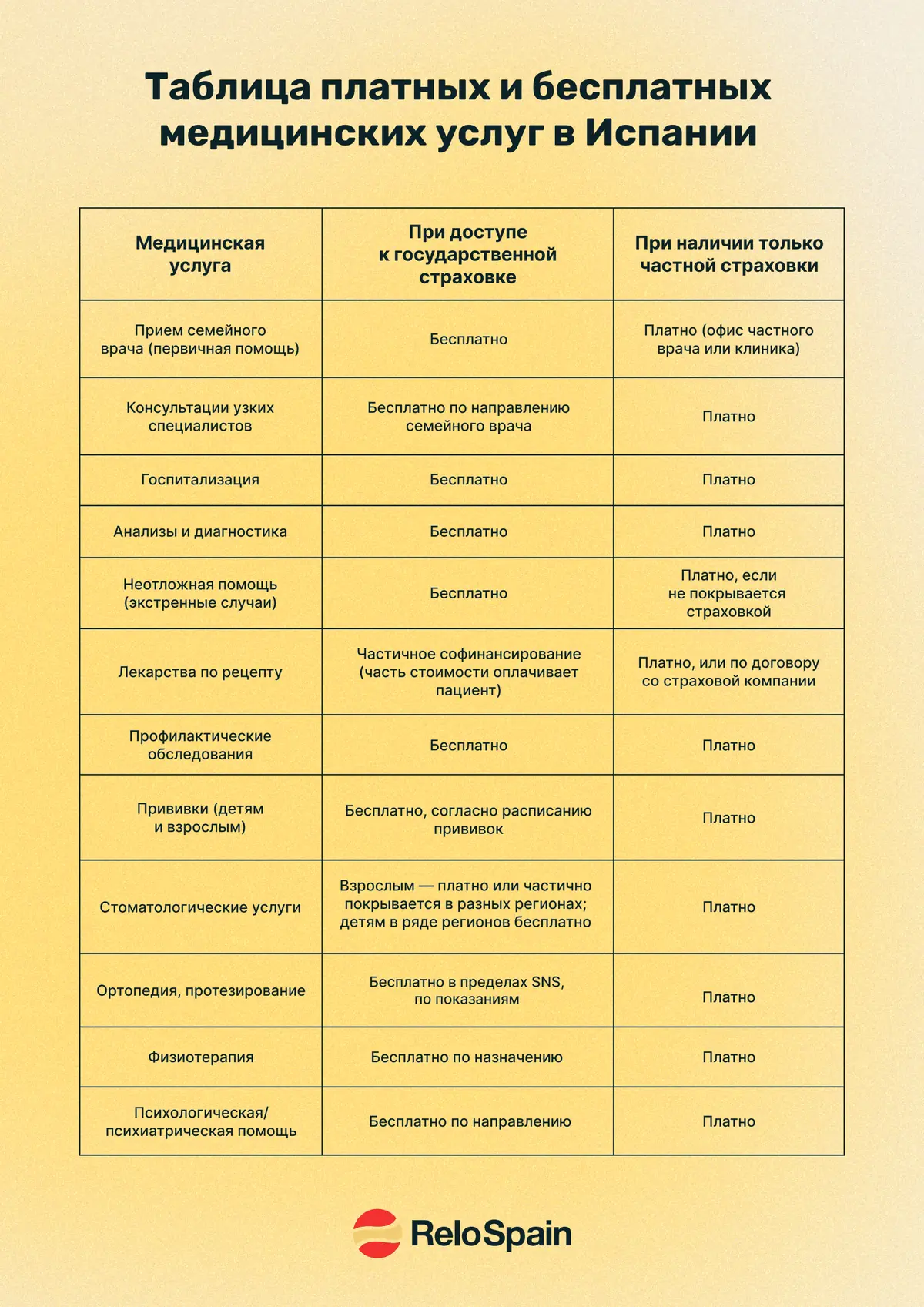
Now let's break down with a clear example which medical services in Spain are paid and which are free. We have outlined this in the table below.
If you have chronic illnesses and are planning to move to Spain, it is important to prepare thoroughly to maintain the quality of treatment and ensure access to healthcare. What you must do in advance, even before moving, is to gather all medical documents confirming the illness: discharge summaries, medical history, treatment plans, lists of medications, test results, and so on. It is advisable to have everything translated into Spanish or English.
After moving, if you have chronic illnesses, it is essential to register your residence to gain access to the public healthcare system. In Spain, primary medical care is centered around a family doctor, who will refer you to specialists after an examination. You or your family member will need to be assigned to a doctor based on the illness. It is important to ask this doctor whether you can obtain the necessary prescriptions and medication alternatives, or if they need to be imported. Additionally, there are associations for various diseases in the country, such as diabetes and multiple sclerosis, where you can receive informational and moral support, as well as adaptation advice. These steps will significantly increase your chances of a comfortable and safe life with chronic illnesses.
Child healthcare in Spain is also among the best in the world, and of course, there are many more benefits for children. Children in Spain are guaranteed free medical care until the age of 18, provided they are legally registered in the country. A pediatrician is automatically assigned to you after the insurance card is issued. The child healthcare system also includes emergency care, routine check-ups, all scheduled vaccinations, referrals to specialists, and school and kindergarten documentation.
If your child falls ill, you can either visit a paid pediatrician with private insurance or go to your registered family pediatrician. You should bring the following documents:
By the way, all appointments can be made online — there's no need to go anywhere unnecessarily. You can find Russian-speaking doctors who will see you for a fee based on recommendations. The consultation fee ranges from 45 to 70 euros. The doctor will write prescriptions that you can take to the pharmacy. Additionally, you can find doctors in chats who are willing to come to your home and examine your child. The service fee is approximately 120 euros.
All about childbirth in Spain. Here we reached out for information from Margarita, Dmitry's wife, as she has gone through this process herself and can fully reveal this complex topic based on her personal experience:
"Hello, my name is Margarita from ReloSpain, happy to see you in the Knowledge Base. The topic of childbirth is very important, especially if you are planning to give birth in another country. I will talk about things that every mother should know, based on my own story. We arrived in Spain three weeks before my due date. At that time, we had a special certificate from the hospital, translated into English with stamps and signatures, confirming that I was fit to fly. This is the first thing you need to consider — if you are more than 28 weeks pregnant, it is better to have such a certificate. Three years have passed since then, and a lot has changed.
For example, three years ago we managed to arrange insurance for just 60 euros a year. Now there are no such advantageous offers. If you are pregnant, insurance may cost more, especially in large cities.
Before arranging insurance, it is important to inform them about the planned pregnancy. This point will definitely be taken into account and included in the policy.
If you arrive in the country already pregnant, some services under the insurance for residency in Spain will be included. You will be able to give birth, but accommodation and operational costs are not covered. Sometimes childbirth may not be included in the policy, so for greater certainty, it is better to arrange for public insurance. Keep in mind that in this case, the birth will not be attended by the doctor who prepared you for childbirth. Childbirth in Spain is different from that in CIS countries. There is more attention and care. The equipment is the same, but in private clinics, you can choose your doctor and a private room, and a family member can stay with you as long as they want. So the first two steps you need to take are to obtain a certificate from your doctor and choose a hospital in advance.
Appointments with Spanish doctors are easy and quick. You just need to book and arrive at the scheduled time. The doctor will ask all the necessary questions. Try to bring all your test results from home. It’s good if they are in English and, if possible, in Spanish. Not all doctors speak English. After that, everything is very simple: they will ask you about your well-being, take the necessary tests, and perform an ultrasound. This applies to both private and public medical institutions. In Spain, there is a special approach to medicine. Doctors do not want you to go from room to room and experience stress. All procedures are carried out in one place, without long transitions. This approach is characteristic not only of medicine but of life in general. Spaniards value calmness and measuredness.
In a private hospital, you can book an appointment for your chosen day, while in a public hospital, the doctor will assign the appointment time. You will definitely need the following documents: NIE and health insurance numbers. In Spain, if necessary, you can have an epidural anesthesia or a cesarean section. There are no restrictions: all necessary ultrasounds and tests will be conducted.
The coolest thing is that a child born in Spain can obtain Spanish citizenship after one year of legal residency. There is an important condition: the child cannot obtain residency in Spain if one of the parents does not have a resident card. However, I am sure that such a situation will not arise among our clients. In the maternity hospital, you will receive a yellow certificate. In some regions, a birth certificate may be issued immediately. You need to take this certificate to the Russian consulate. When applying, fill out the template of the certificate in Russian and have it certified there. It is important to do all this within the first month. It is best to contact the consulate. However, there are often long queues, and time may be tight. Life hack: try other cities. There are consulates located on the mainland — there, the reception is much more accessible."
After the child receives Spanish citizenship, parents can reunite with them and apply for permanent residency. This is not temporary residency, but permanent residence in the country for 5 years. The process takes time. The regulation is 3 months: you need to prepare documents, submit an application, and wait for a decision.
With citizenship come new opportunities: visa-free access to 62 countries, simplified online visa to the USA, and access to almost the entire world. A child's citizenship allows for family budget savings. There is no need to obtain a Schengen visa and legalize for studying abroad; for parents of children with citizenship, the document processing process is significantly simplified.
For children, vaccinations are provided for free with a medical card according to the official state vaccination schedule, even if the child was previously vaccinated partially or according to a different schedule — it is important to bring the medical card and vaccination card. For comparison, adults are also provided with free vaccinations in Spain, recommended by the regional calendar for the prevention of influenza, COVID-19, pneumococcal infection, and other diseases at risk. Other vaccinations are prescribed based on the therapist's recommendations. Keep an eye on annual vaccination campaigns — information about them is published in medical centers and on official websites.
As for dentistry, pediatric dentistry in Spain is gradually becoming more accessible due to the expansion of free coverage. With a Spanish medical card, children have access to regular preventive check-ups, cavity treatment, fillings, extraction of baby teeth, and so on, plus teeth cleaning.
If braces need to be placed, teeth need to be aligned, cleaning or implantation is required, all of this is handled by private clinics, with consultation fees starting from 50 euros. Appointments with dentists are made through the local medical center or directly. For adults, almost all dental services are paid, except for emergency care. Free preventive care may also be provided to certain groups: pregnant women, cancer patients, and people with disabilities.
So, we have covered the topic of healthcare in Spain. We are confident that this knowledge will definitely help you prepare before your move, so that you do not encounter problems with medical services once you are in Spain.
Strictly necessary
Required for the site to function
These cookies are essential for the website to work and cannot be disabled. They remember your language preference and your cookie decision so the banner doesn’t reappear
Analytics & performance
Anonymous visit counting
Let us count visits and traffic sources (search, social, direct) to understand page popularity and improve the site. No personal data is collected
Your rights
You can change or withdraw your consent at any time by clicking «Manage cookies» in the site footer. This is as easy as giving consent. You also have the right to access, correct, or delete your data by contacting us at hello@relospain.com