What happens to your motivation, expectations and emotional resources during the move and after it.
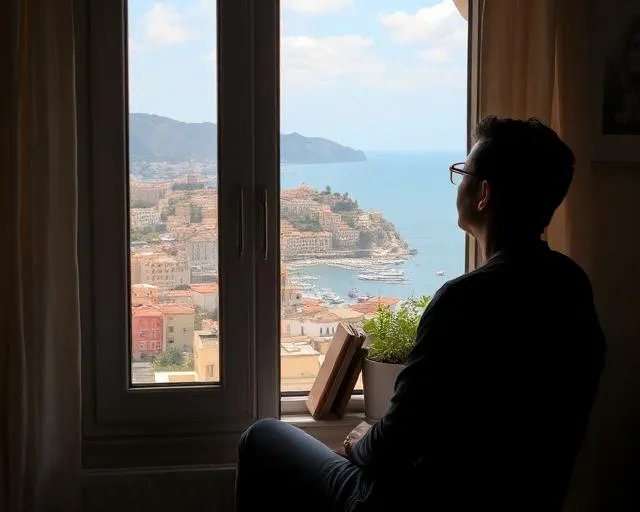
Is it true that Russians aren't treated very well in Spain? Is it true that living in Spain is much more expensive than in Russia? Is it true that it's hard to find work in Spain?
All these myths can create a false picture of what awaits you after relocating and cause general anxiety around the move, which can lead to wrong decisions.
In this article we'll talk about the deepest topic in the whole Knowledge Base: the psychology of relocation. It's important to talk about the psychological processes every expat who's moved to Spain goes through: how to always keep yourself in good emotional shape, not give up, not pine for home — how to set yourself up for new accomplishments and the achievement of goals in a new place.
Relocation isn't just a change of address. It's a psychological marathon in which you'll experience different emotions, encounter unexpected obstacles and discover information that was previously unknown to you. So if you're planning a move to Spain, it's time to understand what's going on inside you at each stage and why it's normal.
With our help, 2,500 clients have already opened up borders and previously unavailable opportunities, and we know inside out all their psychological fears and barriers that can hold people back from moving. And it's no news that there are quite a few people who sit with certain beliefs in their heads and wrongly perceive the information they've received as the truth.
The founder of the company, Dmitry, helped us write this article. He knows better than anyone what it's like for expats in Spain: Dmitry moved to Spain with his family in 2022, arranged the startup visa from scratch and experienced many tough processes firsthand.
"One of the main myths is that Russian speakers are treated badly in Spain, that nobody there wants us because we're newcomers
I've lived in Spain for more than three and a half years and have seen for myself how mild and tolerant the people here are. Tolerant in the sense that here no one will, so to speak, judge you behind your back: by how you look, by how expensive the watch on your wrist is — no, here everyone is equal, there's no social hierarchy. On the contrary, people are interested in where you came from, ask questions about your culture, learn something new and try to help you with the language if it's hard: here the attitude of one person to another is built on mutual understanding.
Personally, in all the time I've been in Spain — and my family and I have lived both in Tenerife and now in Barcelona — I've never seen any disdainful attitude towards Russian speakers, nor heard such stories from my acquaintances and colleagues in Spain. Spain receives more than 5 million foreign tourists a year. It's a country where immigration is the norm, not the exception. People here are already used to accents, language mistakes and different cultures. Moreover, by official counts more than 200,000 Russian speakers live in Spain, and the overwhelming majority of them are Russian citizens.
Living in Barcelona myself, I hear Russian speech; I already know the places where Russian expats gather, and believe me — there are plenty of such places. Every Spanish city already has its own Russian-speaking community. In Barcelona, Madrid, Valencia and the Canary Islands there are Russian-speaking schools, psychologists, hairdressers and doctors.
So the fear that no one will want you in a foreign country, that you won't be able to find compatriots, that someone will give you a sideways look — all of this contradicts the real situation. It's an imaginary fear that often arises from the very thought of moving to a new country. The main thing is to be able to tell fears apart from reality.
Many objections and fears are connected with a lack of information. And searching for this information online isn't enough — different sources may say different things, and there's a practice where some unscrupulous agencies frighten potential expats with certain topics, taxes for example, along the lines of "if you don't apply with us, you'll get hit with fines and interest." And then, after such statements, people come running to us for a consultation upset that they'll have to pay hefty taxes as a resident, not knowing about the alternative options.
That's exactly why you should stick to the rule — there's always a way out. Ask yourself the question: am I really sure that in my situation there's no other solution?
If you ask each of our clients who've already obtained Spanish residency, ourselves, and our acquaintances who've also gone through the relocation path, whether there was anxiety before the move — we'd all say "yes" in unison, but the root of this anxiety came precisely from there being a lot of information that was unclear to us and hard to make sense of.
Questions immediately arose: What documents are needed? How much tax will I have to pay in Spain? What do I do if a follow-up request or refusal comes, and so on. Now you can find the answers to all these questions in our Knowledge Base — we created it precisely for this. Here's everything about what you'll have to go through if you're going to move. So I recommend watching all the videos — it will definitely give you the right picture of how relocation to Spain works.
Sometimes what holds people back from relocating is the very fact of leaving their "usual life" — a change of residence, of surroundings — all of these are so-called "changes," and not everyone can be ready for them. But know this: you aren't leaving anything behind forever. Friends remain friends in the internet age. Video calls, Telegram, visits during the holidays — all of this is possible. You aren't breaking off relationships, you're changing the format. What's more, a residence permit doesn't force you to be in Spain all the time: you can not live in the country at all, leaving and arriving whenever you want. Residency is, first and foremost, freedom of action, the chance to discover the world, rather than swapping one set of borders for another.
The strongest doubts usually come in the first 90 days before the move, when it seems it's still a way off but you already need to take some action, and they're expressed in fairly everyday questions: "How will I cope with the language, work, daily life? How will I live in a country with new laws, where I might be fined and not understand what for?"
When there are no answers to these questions, the preparation process gradually grows into stress. How do you fight this? There's one universal solution that helps — look for as many people as possible from your future environment. On Instagram, on Telegram, on forums — don't be afraid to search, write and build connections.
This helped us greatly — my wife Margarita followed many bloggers who made content about life in Spain, even wrote to some of them personally, and they replied to her. Even in advance, several months before the move, we knew where to go for inexpensive but tasty food, how to visit hospitals and clinics, which key phrases you can't do without in Spain, how to call an ambulance and much, much more.
Another of the common fears we hear from our potential clients is that expenses will increase greatly, that living in Europe is much more expensive and that you might simply not be able to "manage" financially. This is an extremely common stereotype and another myth — expenses here don't differ much from the CIS countries. Especially for you we've calculated an average monthly budget for one person. The table is below. And, of course, you can download it at any time.
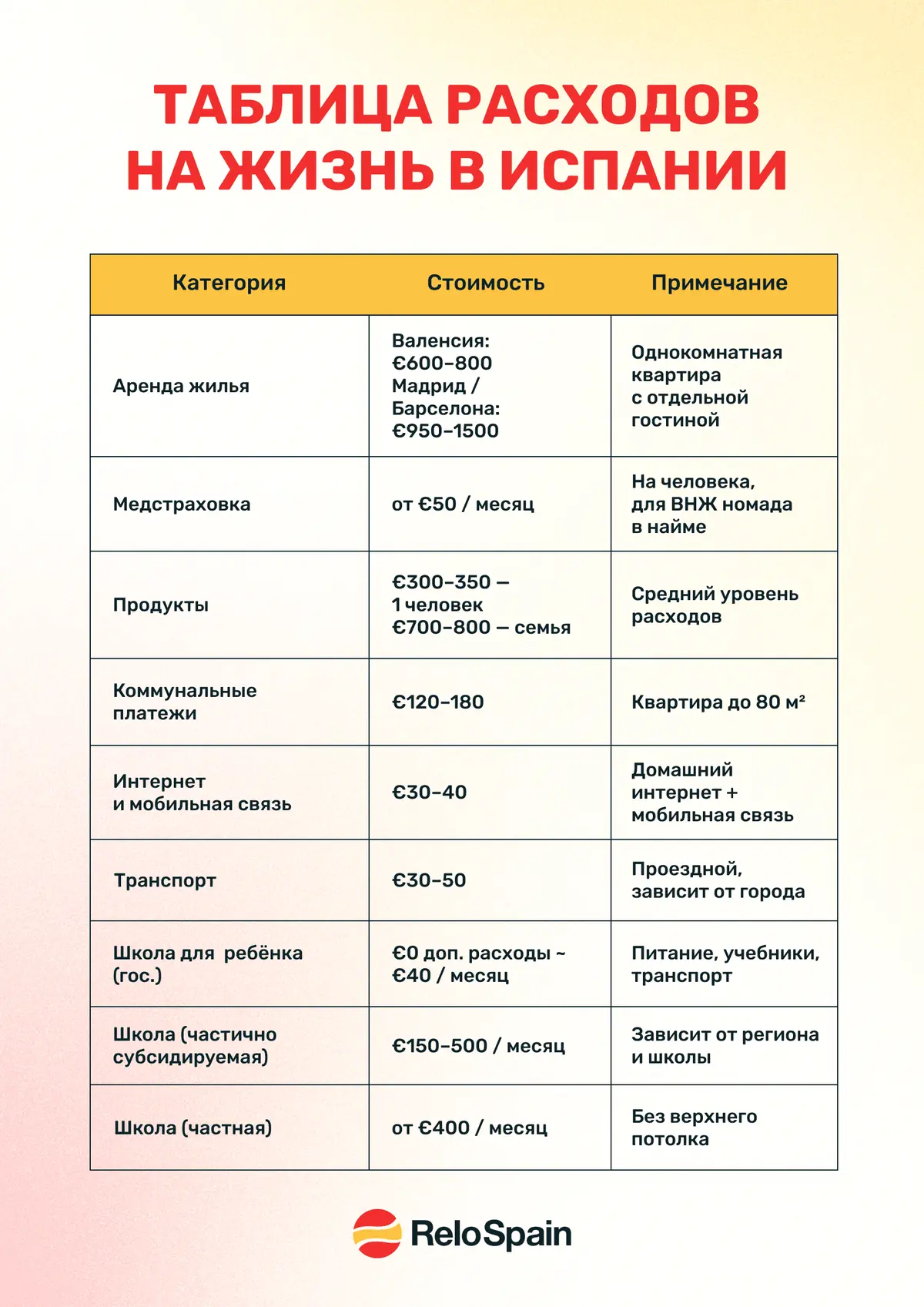
I'll just sum up how much you'll spend on average each month living in Spain: For 1 person in a large Spanish city: that's spending from €1,100-1,300 a month. For a family of three with a child in a public school: spending from €2,300-2,600 a month for the whole family. Very close figures to Moscow, and that's bearing in mind that the average salary in Spain is much higher. You don't need a lot of wealth here to afford some basic things. The same groceries, especially fruit, are much cheaper here than in Moscow, and their quality is higher.
Now about expectations. All these fears, doubts and objections stem from false expectations, which are often reinforced by myths, stereotypes and unverified information. That's why it's so important to talk with those who've fully gone through the entire relocation path and know all the ins and outs from the inside. You shouldn't build up any expectations, because there's always a high chance that these expectations won't ultimately match reality, and that's a direct route to stress and disappointment.
It's important to have a clear action plan that will lead to a result and to carry it out gradually. And that's exactly what we help with — at a free consultation we discuss clients' cases in detail in order to put together a personal plan for obtaining a residence permit depending on the goal.
I'd also like to share my own emotions and experiences connected with moving to Spain. My wife Margarita, our son Artyom and I made a joint decision to move, and this gave us the strength to cope with stress. What mattered was that no one was persuading anyone — it was a mutual decision, and the very thought that all the family members you're going to move with share common goals and desires charges you with extra motivation.
Personally, I had no fear of moving to another country. Why? Well, first, we knew where we were going, the customs and features of life in Spain: we'd been to this country more than once, and that, by the way, is a very cool strategy — first to come to the country as a tourist, see how people live, what the climate is like, talk to the locals, live a little in the new conditions — all of this really helps you feel more confident before the move, and in our case that's how it was. We all understood that the move was a serious step, and so we'd already started studying the workings of everyday life in Spain in advance: healthcare, schools, deliveries, taxis and so on.
And also, when we were in Spain as tourists, in Tenerife, where we eventually moved, we met our current family friend who, like us, was from Russia. We were very lucky that on our very first trip we found a person from the same culture and built good, friendly relations with them. This led to the thought that no one was waiting for us in Spain falling away by itself — now there was definitely a person there who was waiting for our arrival)
And there were also acquaintances we found across the internet — we just met them, learned that they live in Spain, found common topics and developed quite good, friendly relations. I say this to point out that in the modern era distance and the ability to fly to another country don't stop us — you can calmly form good relations with a person from the country you're going to move to, and in that case you'll even have more motivation to meet in person.
The hardest part turned out to be the last days before departure. That very moment when the bags are packed, the flat is empty, and the realisation comes that very soon your new life in a new place will begin. Until that moment we'd been busy with documents and packing, and somehow didn't really realise or think about the fact that we'd no longer see our familiar home. And when that very D-day came, this thought was one of the first to arrive. At such moments you experience various feelings: sadness, joy that everything is going to plan, and nostalgia for the times of the ordinary.
Although we made the decision to leave, it was sad to leave the place where we'd been happy. However, it's normal to feel sad when you leave a piece of your life behind. But it's important to understand that we're doing this not for the sake of suffering but for the sake of a better future. And that thought gave us furious motivation.
Also about what, in our particular situation, helped minimise stress after the move: it's that from the outset we started treating the new home as our own and didn't put up with things that we as a family didn't like — for example, we immediately changed the curtains and ordered new light fixtures on Amazon. Even something as small as a shower curtain can spoil your mood a lot. It's very important to create coziness in a new place, and it's not always a story about "big spending": you can start with small things — for example, buy 1 vase and refresh the bouquet every week to match the interior — it's inexpensive but adds +100 points to coziness and mood.
It's important to surround yourself as much as possible with things that please the eye, to create a cozy corner — so that you have a sense of home, a place it'll be pleasant to come to after a working day or a walk.
As a plus, if we're talking about your emotional state after the move, then Spain is probably the best place against sadness and burnout. The climate plays a very important role here: the sun, which shines here almost all year round, the sound of the sea, the clean air — all of this lifts your mood. It's very rarely overcast here. And the Spaniards themselves are very welcoming and friendly. They have no snobbery or indifference towards people. They're always smiling, polite and ready to say hello. Even if you don't speak Spanish, they still try to make contact.
It's important to be open and ready for new acquaintances. In Spain people really do help each other. In some other countries of Europe society is arranged differently. There the shop assistants can be strict and prim, and a move can be even harder because of the aggressive environment.
So I always advise finding people in your new city in advance. Write to them on social media, invite them for coffee, ask any questions. This will help you adapt more easily. After all, even one person you can discuss something with in a language you understand can make the situation much easier.
If you're going to move with the whole family, it's important to arrange everything so that none of the family members experiences stress. And there's one strategy that helps do this: reconnaissance. Its essence is that you or one of your family members can come to Spain in advance on an arranged visa, live there, learn from the inside how everything works, and only then make a decision. What's more, we have quite a few reconnaissance cases where our clients arranged a permit for themselves first in order to come to Spain, live there alone, test the ground, and then add the whole family to their existing Spanish permit.
Here's an example of such a reconnaissance case from our client Andrey:
He'd long thought about moving to Spain. He worked as a manager in employment while also running a business in the building-materials trade. Everything was already heading towards starting a life in a new country, but his wife and daughters, unlike him, weren't yet ready for the move. And here we offered Andrey a no-lose option: to start by arranging a permit for himself, travel to the country "on reconnaissance," study how Spaniards live and how comfortable the climate is, and only then add and move the family.
In the end that's what we did with him. We prepared all the documents and handled the submission while Andrey waited for our answer. The result: approval in 22 working days, 0 follow-up requests! 🎉
The story didn't end there: when Andrey flew to Spain for the submission, he realised it was still hard for him without his family. He started thinking about whether to halt the process. But the manager reminded him: the issuing of the TIE card can always be pushed back and you can take a pause for adaptation, collecting your thoughts and preparing the family. Andrey decided to use this option and return to the process in the autumn.
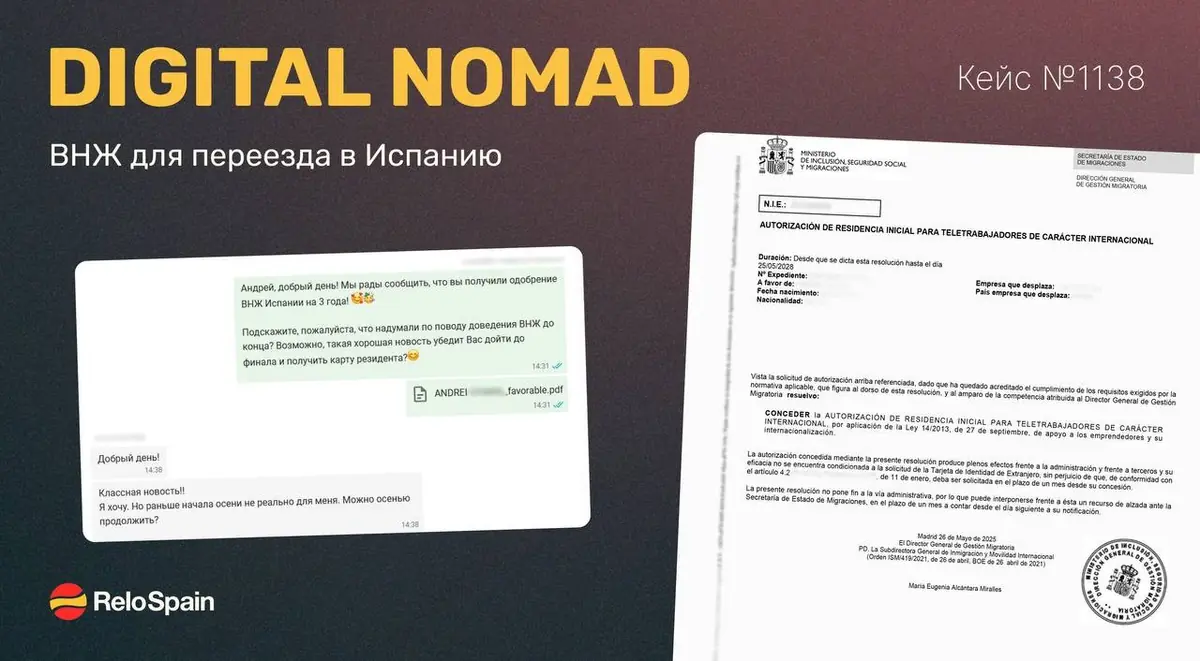
This shows the versatility of the approach to arranging a permit — you can arrange the documents now, while the requirements are lenient and the euro exchange rate is reasonable, get approval, and then, if necessary, postpone the process of getting the card, calm down, prepare everything and within a few months come to give your fingerprints and arrange the resident card. And later move the family, when everyone is ready.
We don't recommend rushing headlong with burning eyes to get approval and move as fast as possible — we're still in favour of a considered approach, and always advise first weighing everything up, and then, if everyone agrees and there are no doubts left, coming to us to arrange it.
It's important that you can ask yourself the question: "What is relocation for, for me or my family? Do we even need to move?"
The answer to this question will be your reason for moving, the main point of support that will help you stop being afraid and focus on your goal. We're all adults, and if we need something, if we have a weighty reason for it, we go and do it however hard it may be, looking for any ways to achieve the set goal. If you have no clear answer to these questions, then really, why move at all?
In any case, you need to understand that there will always be doubts, and that's normal. Relocation is, first and foremost, a choice that should be based not merely on the thought "it'd be nice for us to move" but on the fact that at this moment it's the best option for you, one that will help change your life for the better. If you believe in this, then your inner confidence will lead you forward. The main thing is to prepare for the move in advance. The more information you have, the easier the move process itself will go. Anxiety arises when you live in uncertainty. Then you start imagining things and anticipating. Starting to get to grips with the topic is the best tactic.
And that's easy to do: you can always rely on us.
Choose any option, and ideally combine all three. Our goal is to help you cast aside all preconceptions and stereotypes so that you can clearly understand how relocation to Spain works, which documents to submit and what awaits you after the move. We want you to get a clear answer to the question: do you need to obtain a residence permit, and how do you do it.
Strictly necessary
Required for the site to function
These cookies are essential for the website to work and cannot be disabled. They remember your language preference and your cookie decision so the banner doesn’t reappear
Analytics & performance
Anonymous visit counting
Let us count visits and traffic sources (search, social, direct) to understand page popularity and improve the site. No personal data is collected
Your rights
You can change or withdraw your consent at any time by clicking «Manage cookies» in the site footer. This is as easy as giving consent. You also have the right to access, correct, or delete your data by contacting us at hello@relospain.com