Employment formats, remote work, contracts and how not to get confused between the different setups.

How do you get paid in euros, have official benefits or close out projects while sitting on the beach and enjoying the sound of the sea in Spain?
A very important topic for those planning to work in Spain.
In this article we'll answer the following questions:
The unemployment rate in Spain is 10.45%% — one of the lowest figures in the country over the past 17 years (since 2008). And the average unemployment rate in Spain since '76 is 16.07%%.
Yes, by official data this is much higher than in Russia, but there are explanations for such figures. Spain has historically high structural unemployment going all the way back to the 1970s, and this is connected primarily with the country's way of life and the large number of temporary contracts that aren't included in the overall count. That is, there's no cult of work life here; people don't strive to overdeliver on targets or for a higher position — the average salary here is high, and for many it's simply enough to "be" at their workplace, work their hours and go home. Few reach for a high salary; many live in comfort.
Spain also has high youth unemployment. Even after it fell in 2024-2025, the unemployment rate among young people remains one of the highest in the EU — and that's exactly why many Spanish companies bet on foreign specialists. If you're a top-class specialist in your field and come to Spain, you won't face serious competition from the locals here.
22.3 million people work in Spain as of 2025 — a historic record.
Annual growth: +584 thousand jobs compared with 2024. And expats also played no small part in this: according to the latest statistics, about 2.4 million foreign citizens work in Spain. That's roughly 10.7%% of everyone employed in the country. So for many companies it will be a plus if you express a desire to work in Spain.
An important point to consider is that to get a good position at a large Spanish company, you need to know Spanish. For international organisations it's important to know English. Without the language it's hard to compete — a candidate who knows the language perfectly will be preferred over one who, say, has more experience but knows Spanish or English poorly. Yes, in Spain you can also work for Russian employers, but even in such cases knowing Spanish is still useful, since in your work you'll be communicating with Spanish speakers one way or another.
The average annual salary in Spain in 2025: 29,113 euros (2,426 euros a month). The average monthly salary after taxes: €1,700-€1,900 depending on the region, sector and tax situation. A bit more than the average figures for Moscow
5th place — engineers; in Spain their average salary is €35,000-45,000/year. Next come IT specialists — where would we be without them — with an annual figure of €37,000-50,000/year.
3rd place — financial managers — about €47,000+/year. Followed by lawyers — about €60,000-70,000/year.
And the highest-paid profession is doctors, €6,000/month, which is about €72,000/year. Medicine here is at a high level — in Spain cancer and the most serious eye diseases are treated for free, so doctors' pay is more than worthy. So if you're an experienced and promising doctor, all roads are open to you to build a successful career in Spain.
Spain is the growth leader among the large EU economies: in 2024 GDP grew by 3.4%%, and this year by 2.4, which is above the EU average growth. And all of this isn't without the help of relocators, who also influence the economy — perhaps that's why Spain is the most accessible country in Europe for obtaining residency.
It's better to do this in advance. Below is a list of sites for finding work in Spain.
It's worth paying attention to the international service LinkedIn. It's a professional social network where you can describe your activity in detail, and it's very popular in Europe. Here specialists look for professionals for their projects and businesses. You can also look for vacancies on Facebook, but the audience there is less qualified. Usually people there look for job seekers who've only recently moved and are searching for their first job.
Before you start looking for work in Spain, you need to decide on your goal: if your goal is to work in Spain for a Spanish company with a local employment contract, then you need to arrange a permit under the "Startup" or Cuenta Propia — it gives an unlimited right to work for the applicant and their family.
If your goal is to work from Spain with clients all over the world or with companies from the EU, then you can arrange the Digital Nomad permit — it gives the right to work from Spain, but with restrictions — you can receive no more than 20%% of your main income from Spanish clients or from companies registered in Spain. The restriction applies only to the main applicant; familiares can work without restrictions. In any case, if you want to work from Spain but don't know which permit to choose for this, turn to us — we'll go over your case and choose a suitable option.
First you need to register with SEPE (Servicio Público de Empleo Estatal) — this is the official way to become a registered job seeker in Spain. Roughly speaking, it's a service that, after registration, automatically places you in the database of job seekers and opens up access to public employment services, benefits and a support programme.
First, you need to prepare the following documents:
Next you'll need to create an account in the Cl@ve system:
This is the single digital identification system for Spain's government services. Registration happens online.
After that you need to book an appointment at an official SEPE office or apply online. Then you'll be issued a job-seeker's card (tarjeta de demanda de empleo):
After this you can calmly look for work. The process is the same as everywhere: you create a CV in English and Spanish, also write a cover letter describing your soft and hard skills and experience, and prepare a portfolio. You upload all of this online and send your applications through the services — nothing new here. The selection itself takes place in 2-3 stages: an application form, sometimes a test assignment and an interview, sometimes a first interview and then a second. The selection practice doesn't differ much.
It's worth clarifying what recognition is — it's the official recognition of a foreign diploma as equivalent to Spanish education. Recognition in Spain is required for regulated professions, that is, those for which you need a special permit or licence from the state. Examples of such professions: doctors, dentists, nurses, pharmacists, teachers in public schools, lawyers, notaries, engineers (in certain fields), architects, psychologists (in clinical practice).
In these cases homologación is required — so-called full recognition of your professional fitness, and you may need to sit exams or complete an internship. Recognition isn't mandatory but may be required if you work in the private sector, where having a diploma matters but the profession isn't regulated by law.
In such cases it may be enough to provide:
Recognition isn't required when the profession itself doesn't require a diploma (for example, in services, logistics, elderly care, construction and so on). Or if you work as an entrepreneur or freelancer, and if you have a diploma from an EU country.
Under both the Nomad and the Startup, the family can work in Spain without restrictions. But there are small differences: with the startup permit the main applicant can also work without restrictions. With the Nomad, however, the main applicant can receive only 20% of total income from clients or companies registered in Spain.
Now a little about contributions. If you work officially in Spain under an employment contract with a residence permit, by law the employer withholds and pays all mandatory contributions from your salary. You personally pay nothing beyond this. But if you're a freelancer, you must be registered as an autónomo and make the following payments:
Gather 3-4 types of confirmation. All documents must be translated and cover the most recent year. Any freelancer must register as an autónomo if they want to work from Spain.
Then, step by step:
Step 1: you register online with the Agencia Tributaria, which is the tax authority. You fill out the Modelo 036 or Modelo 037 form — stating your type of activity.
Step 2: next you get a NIF number, if you're a legal entity. This can be done online with a digital signature or in person by appointment — here you'll need a cita.
Step 3: you register with Seguridad Social, with social security. You submit the TA0521 form — an application to start activity
It's done within 30 days of registering with the tax authority. After registration you get access to social security and the medical system. Registration is mandatory if you want to work legally in Spain. Without it you won't be able to work with companies or large clients above board — since you won't be able to issue an official invoice, that is, a bill for payment
Here we can't help sharing an example of a successful case of our client — Sergey. He fell foul of a sad reality: European companies rarely sign contracts with non-residents because of strict labour laws, and in some countries work visas aren't available at all with a Russian passport. Sergey had a similar situation: he's an IT specialist with 12 years of experience, received an interesting offer from a Czech company, but ran into difficulties — in the Czech Republic a work visa isn't available to citizens of Russia ❌
So as not to miss the chance to work at a promising company, Sergey came to us for a free consultation, where we quickly found a solution — the Spanish employed nomad permit. It was important for Sergey to be minimally involved in arranging and submitting documents, and also to be able to speak with a gestor to optimise his tax burden. So he took the "Comfort" plan, which includes our end-to-end work and a consultation with a tax specialist. In the end, with our help, Sergey got approval in 17 working days and 0 follow-up requests!
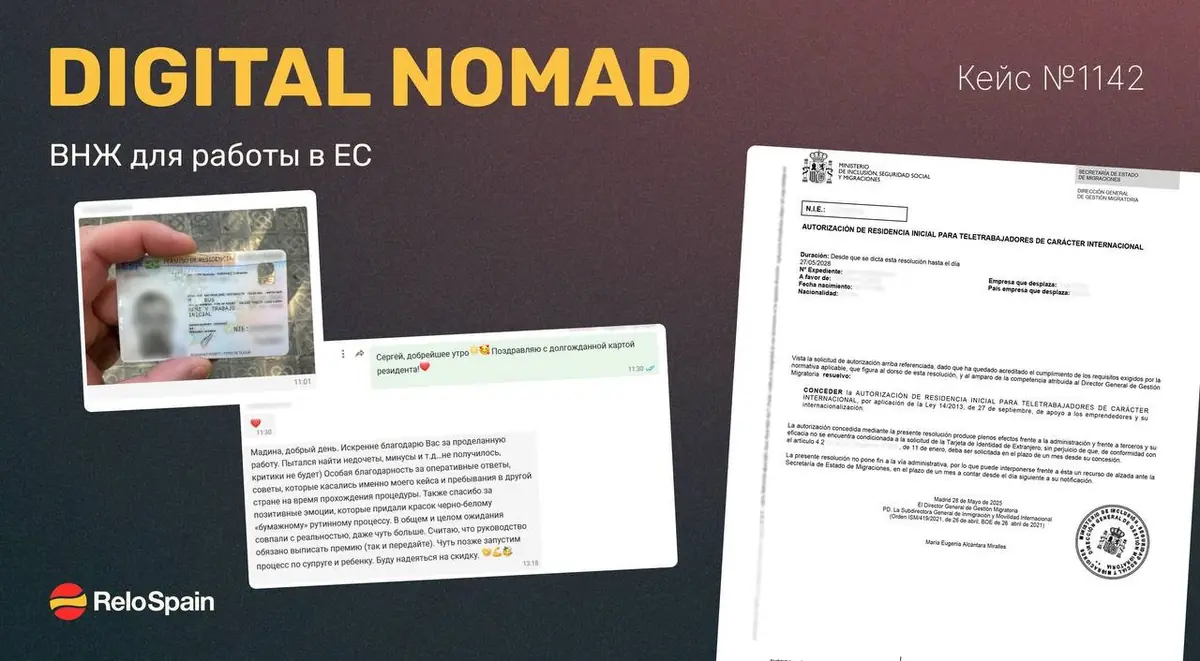
So with a Spanish resident card we opened the road to his career in Europe for Sergey. That's exactly why a residence permit is a universal tool.
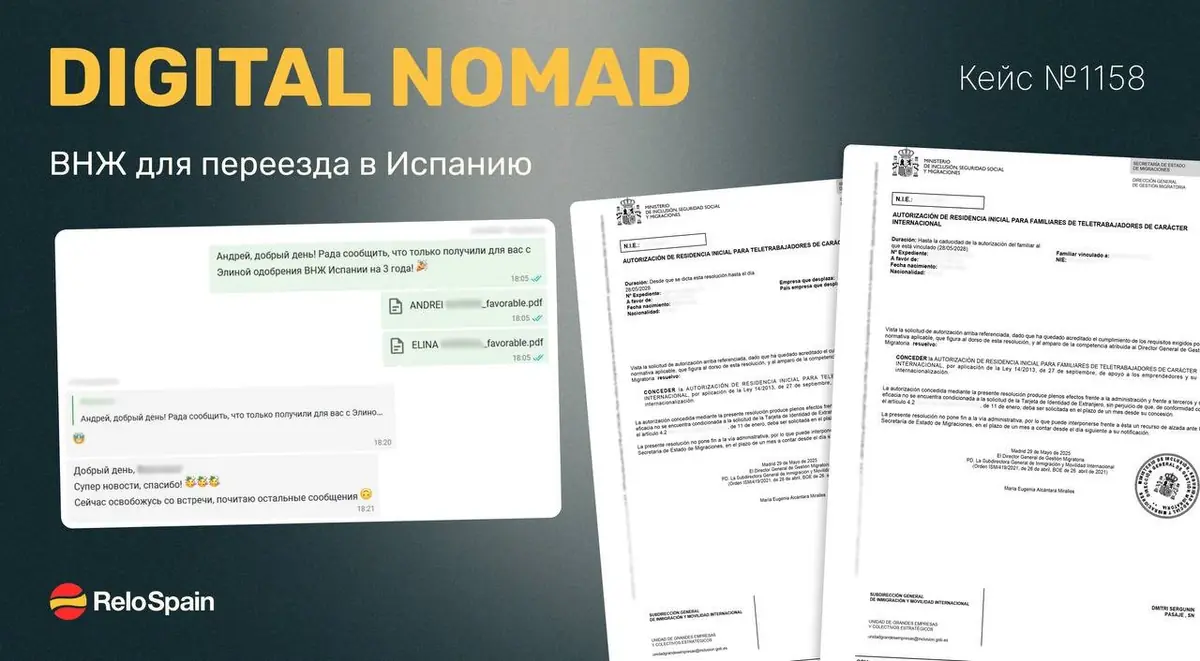
Or another example — our client Andrey. He lived in the Netherlands for 2 years with his wife and dog, but he didn't much like the climate — he wanted more sun and warmth, the sea "close at hand," and so the choice fell on Spain. Andrey is a developer of gaming and CRM projects and works with international clients, so it was important for him to stay connected with such clients from Spain. At a free consultation we recommended the nomad-autónomo permit to him.
🔥The result: approval in 14 working days and 0 follow-up requests.
But the story didn't end there — after getting his resident card he received a new offer: contract work at a European company. Andrey decided to change his status and, again through us, reapply for the employed Digital Nomad permit. Yes, this can be done easily — if for some reason you need to change your residency, you can turn to us — we know how to do it without refusals. Now we're preparing his documents.
There's always a chance — and if you're consulting with someone and feel anxious, or that you have a high risk of refusal — come to us. Or if, after getting a permit, you're told you risk being hit with large fines. In most cases these are merely marketing tricks from unscrupulous companies and agencies trying to scare you. In practice it's different: in any case a solution can be found. If something is troubling you, you can always contact either our manager through the work chat, if you already have a permit, or come to a consultation with an expert and discuss all the "thorny" questions of arranging a permit, as well as put together a personal plan for getting approval.
Strictly necessary
Required for the site to function
These cookies are essential for the website to work and cannot be disabled. They remember your language preference and your cookie decision so the banner doesn’t reappear
Analytics & performance
Anonymous visit counting
Let us count visits and traffic sources (search, social, direct) to understand page popularity and improve the site. No personal data is collected
Your rights
You can change or withdraw your consent at any time by clicking «Manage cookies» in the site footer. This is as easy as giving consent. You also have the right to access, correct, or delete your data by contacting us at hello@relospain.com